Why a pocket on a legging is harder than it looks, and how to tell a real one from a photograph
A pocket sewn into a stretch knit has to hold a phone through a run without sagging, without a seam that chafes and without showing a lump. Where the good ones sit, what the waistband pocket is for, and which of our pairs carry three, four or five.
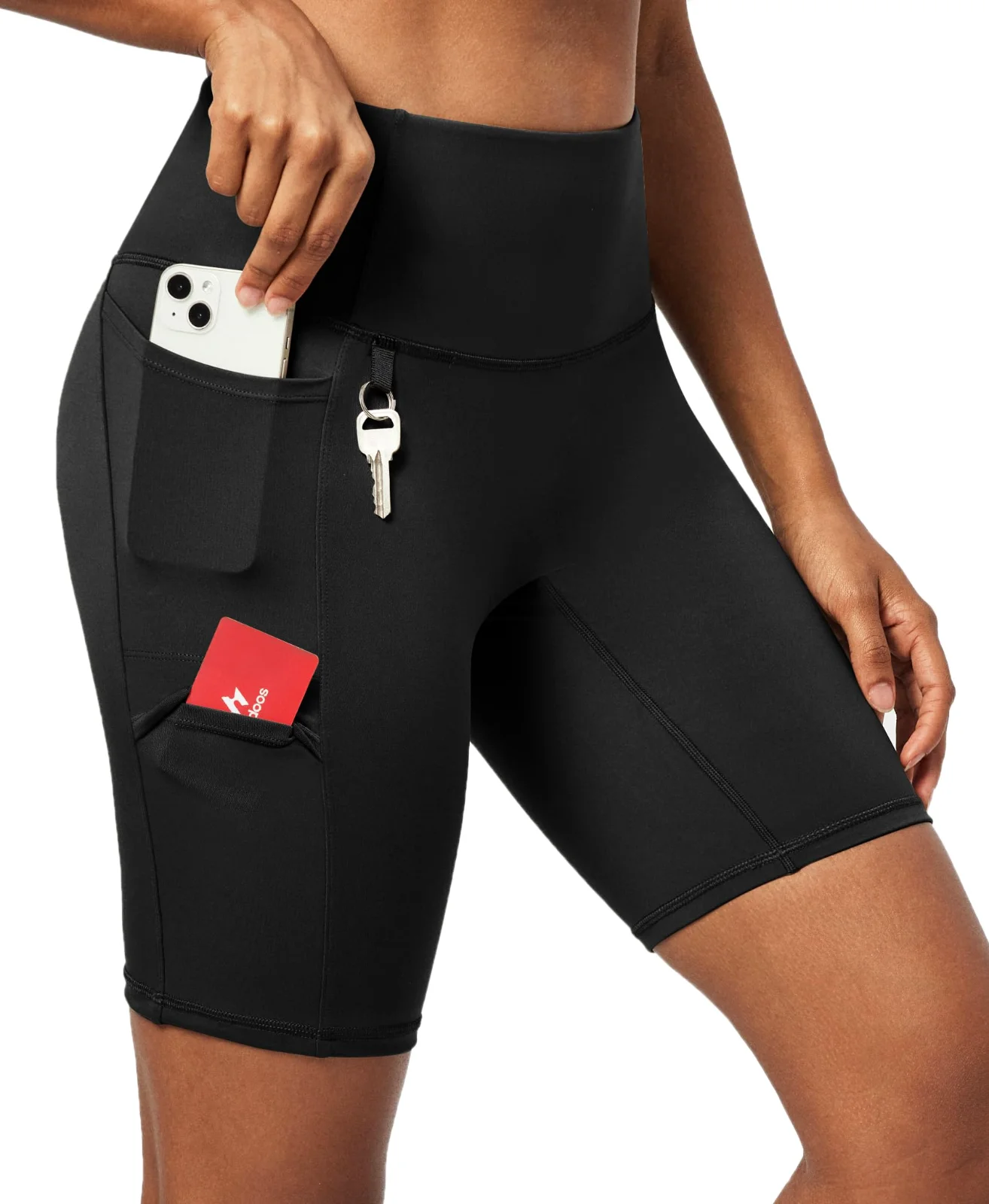
Why a pocket on a legging is harder than it looks
A pocket in a stretch knit faces a different set of problems than a pocket in a woven trouser. Woven fabric holds its shape. Stretch knit moves with your body and with what you put into it. A pocket that is simply cut into a stretch fabric will stretch into a sag or a lump unless the knit around the opening is dense enough to resist that pull. So the pocket has to be drawn for movement: for how a phone shifts when you run, sit, bend, or cross your legs.
Fit plays a role too. When the opening sits toward the front of the thigh the contents can fall forward and bounce. We place our side pockets on the outer thigh where a hand naturally falls. That placement keeps a phone from sliding toward the seam when you walk or jog. The pocket bag itself matters. If the bag is attached to the inner layer of a double knit the seam sits against the leg and the phone presses into the skin. A pocket made from the outer layer holds its shape away from the body.
Depth is the simplest check. A true pocket will be deep enough that a phone in a case sits flat against the leg and the top of the phone stays below the opening. We build that depth into every legging and biker short we make. The difference shows up in photographs, in the way the fabric moves on a run, and in how often you have to fumble to fish a phone back out.
The side pocket and the four things that make it hold
Most of the time a side pocket succeeds or fails for four specific reasons. First, the knit around the opening must be dense enough not to stretch into a lump. Second, the opening must be placed where a hand naturally falls on the side of the thigh and not at the front. Third, the pocket bag should be sewn to the outer layer so the seam does not sit against the leg. Fourth, the pocket must be deep enough so the top of the phone sits below the opening.
Every legging and biker short we make has two side pockets, one on each outer thigh. Those pockets are cut deep enough that a phone in a case rides flat against the leg with the top of the phone below the opening. A phone that rides flat does not bounce when you run. It does not make a lump when you bend. It feels like a part of the garment rather than like something you are hauling.
| Kind of pocket | Where it sits | What it holds | What goes wrong when it is badly made |
|---|---|---|---|
| Side pocket | The outer thigh, where a hand falls | A phone in a case, flat against the leg | Cut shallow, the phone rides above the opening and bounces |
| Waistband pocket | The back or side of the band | A card, a key, a hair tie | Cut deep, a phone in it drags the band down |
| Zip pocket | The waistband or the thigh, on the hiking and winter pairs | A phone or a card that must not fall out | A zip on the wrong side rubs a pack or a saddle |
| Cargo pocket | The thigh, on the hiking pairs and joggers | A bar, a map, gloves | Attached to the inner layer, it swings and crowds the leg |
| Shorts pocket under a dress | The thigh of the sewn-in shorts | A ball and a phone | Cut into the skirt instead, it swings with the hem |
Not every pocket needs to be the same knit. For lighter days a softer opening is pleasant. For trail runs the knit around the opening has to be denser. That is the reason the hiking pairs close their pockets with zips instead of relying on the cloth alone.
The waistband pocket and why it is shallow
The waistband pocket serves a different purpose than the side pocket. Most have a third pocket in the waistband. That pocket is intentionally shallow. It is meant for a card or a key. It is not meant for a phone. A deep phone in the waistband can alter how the garment sits and can become uncomfortable when you sit.
The waistband pocket is for the small secure things. When you need something you will not touch for an hour, a shallow pocket under the band is the right place for it, and on the five-pocket legging that pocket has a zip. The point there is low bulk. A shallow pocket keeps the waistband smooth and stops the knit stretching into a roll. That is why you should not expect the same depth in a waistband pocket as in a thigh pocket.
When a phone goes into a waistband pocket that was not cut for it, the phone flips out on a stride or forces the knit to sag. Keep the waistband pocket for a card and a key, and put the phone on the thigh, unless the card for that piece says otherwise.
Zips, cargo pockets, and trail-ready designs
On longer hikes and cold-weather outings pockets need to do more than hold a phone. Zips and cargo closures keep pockets closed during vigorous movement. The hiking leggings we make have two zip pockets and a row of cargo pockets that close. Those features keep small items from sliding free on uneven trails. The hiking shorts also have cargo pockets that close for the same reason.
Our water-resistant fleece-lined leggings have four pockets including a zip. The zip gives you one pocket you can trust with a phone when rain or sweat is a factor. On the five-pocket legging the zip sits at the back of the waistband, which keeps a card out of the way of a hip belt.
Cargo pockets have to be attached to the outer layer so they do not crowd the leg. When they are badly made they bunch at the seam or make a flap that swings as you walk. Think of trail pockets as a small pack sewn to your leg. They do not replace a backpack. They keep the things you will need quickly, and they keep them from falling out.
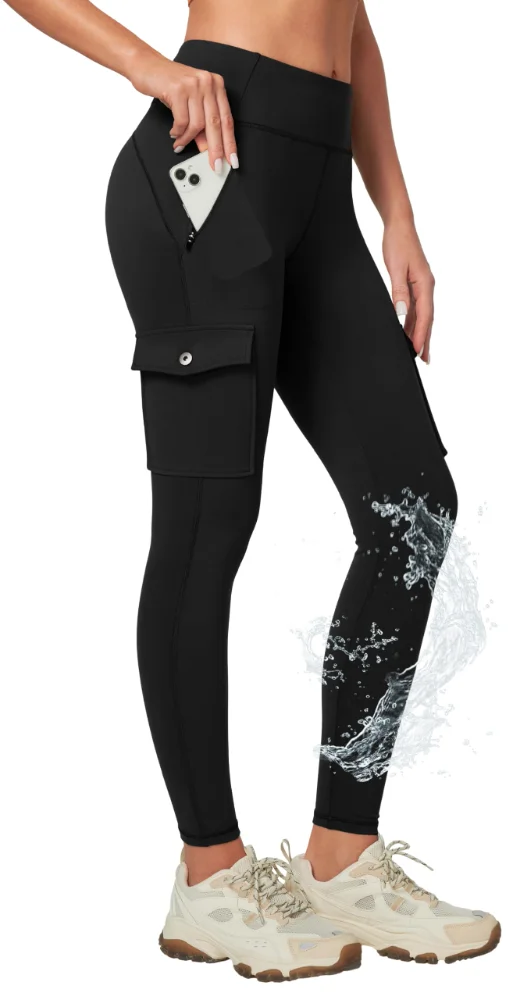
Ewedoos Hiking Leggings with Zip Pockets
4 pockets · UPF 50+ · Water-resistant · Sizes S to 2XL
$27.99
The five-pocket legging and back pockets you can use
The five-pocket legging is the pair for a woman who wants storage without a pack. It adds a zip pocket at the back of the waistband and a back pocket, five in all. That gives you options for what you carry and where. The back pocket keeps small things out of the way when you run. The zip pocket keeps a card or cash against your lower back under the band.
The five-pocket legging comes in a 25-inch and a 27-inch inseam. A back pocket changes how a garment sits on the hips a little, and the wide waistband is what keeps it from gapping. Extra pockets mean extra seams, and every seam is a place where the knit can pull. That is the trade for carrying five things instead of two.
If you carry a phone in a back pocket while seated the contact with a hard surface may be uncomfortable. That is why the back zipper offers security when you are moving and why the side pockets remain the default for an everyday phone in motion.
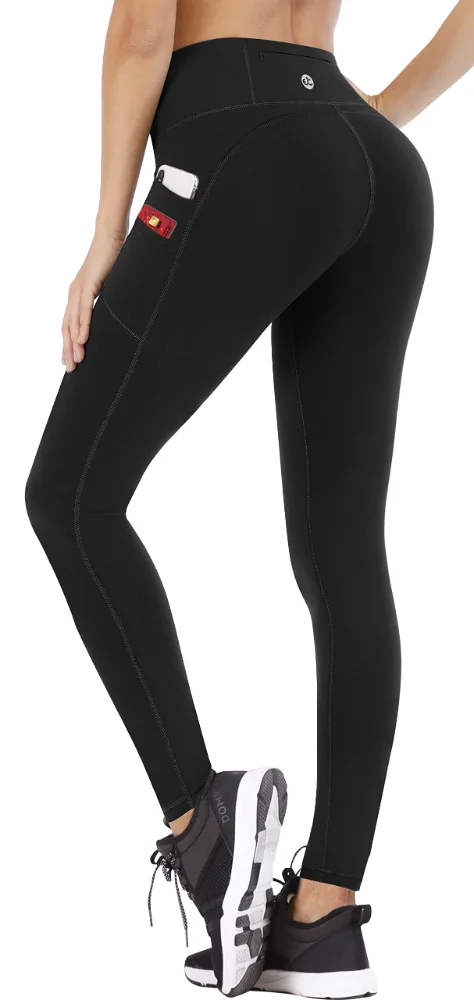
Ewedoos Five-Pocket Leggings, 25 or 27 Inch
5 pockets · Sizes XS to 2XL · Tummy control · High rise
$25.99
Biker shorts, padded shorts, and cycling considerations
Shorts demand a different approach. Biker shorts with three pockets come in a 5-inch and an 8-inch inseam. The four-pocket biker shorts we make have no front seam. Those differences matter both for comfort on the bike and for how pockets sit when you are pedaling. A seam at the front can cause chafing or pressure when you move your legs. Removing it makes the shorts smoother against the saddle.
Padded cycling shorts have no side pockets. The phone goes into a pocket at the back of the waistband under a flap, because a phone against a saddle or falling out at speed is the problem there. The pocket sits behind you so it stays out of the way when you are bent over the handlebars, and the flap keeps the phone from sliding out on a hard effort. The biker shorts with side pockets are for the ride to the cafe, not for long stretches on the road.
If you carry a larger phone on the bike the back waistband pocket is the safer option. The motion of pedaling and the pressure from a saddle make side pockets less secure when seated. For shorter, casual rides the side pockets on a three-pocket biker can be perfectly serviceable.
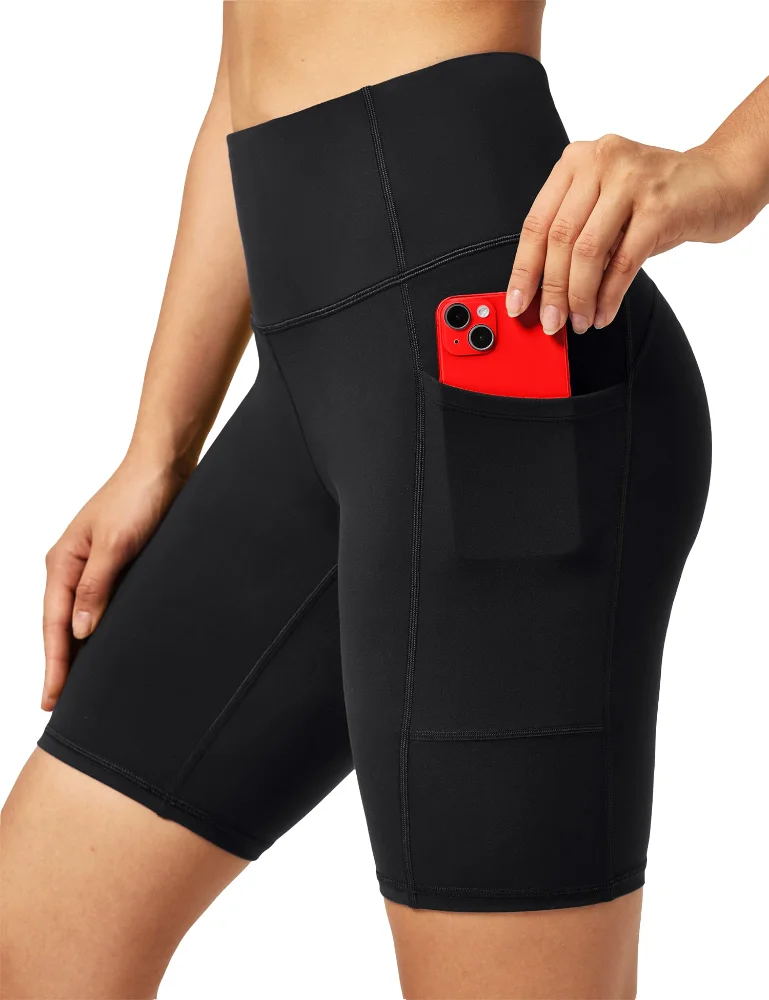
Ewedoos Biker Shorts with 3 Pockets
3 pockets · Sizes XS to 3XL · 5 or 8" inseam · Tummy control
$14.99
How to read a product photograph for pocket truth
Photos can mislead if you do not know what to look for. A hand holding a phone at the pocket opening tells you nothing about depth. A closed hand can hide a shallow pocket. Instead, look for a phone fully inside the pocket with the top of the phone below the opening. A phone sitting flat against the leg indicates the pocket is cut to keep it secure. Another cue is the seam placement. If the seam of the pocket bag sits against the leg the phone will press into your skin. Quality photos sometimes show the pocket bag slightly away from the body. That is intentional.
Check the number of pockets shown. Count them on the card or product diagram if one is provided. We list the pockets each piece has because photographs can only show a single angle. If the image shows a model bending or moving that can hint at how the pocket behaves during activity. Look for fabrics that hold shape around the pocket opening. A knit that collapses into a fold will not keep a phone from slipping.
A photograph that shows a phone sitting inside the pocket is showing you depth, not just placement. When in doubt read the card: the pocket count is printed as a number, and the inseam beside it. A view of the garment from the side shows placement best.
We design pockets to keep a phone flat and below the opening.
What a pocket costs and when we leave it out
A pocket is not free. Each one adds weight, seams, and sometimes bulk that changes how a garment drapes on your leg. A pocket also warms a thigh a little, because it is a second layer of cloth. Where a smooth leg matters more than storage, the pocket is left out. The padded cycling short is the example: no side pockets, because the saddle sets the rules, and the phone pocket moved to the back of the waistband under a flap.
The pull-on dress pants include two real front pockets deep enough for a phone. We include faux back pockets for the line where we want the look without extra bulk. The jeggings have real pockets front and back because the stretch knit and the styling make pockets useful without adding weight. Tennis dresses and skorts carry their pockets on the shorts sewn underneath. That gives you one pocket on each thigh where a ball and a phone go. The 20-inch golf skort adds a zip pocket at the back for extra security when you swing.
Care matters for every pocket. Wash cold, inside out, and hang to dry. A pocket pulled inside out by a phone left in the wash is how a seam goes. Buyers tell us that a phone made bigger by its case still fits, that the waist pocket is the right size for keys, that a runner forgot the phone was on her at all, and that a cyclist wished the padded short had a side pocket. Those four notes say more about where a pocket belongs than any drawing.
More of this sort of thing is in Fit Notes, and the people at Ewedoos keeps the whole range one click away on the front page.