What the fiber label on a legging tells you: nylon, polyester, spandex and the fleece that goes inside
Eighty percent nylon and twenty percent spandex is a sentence, not a spec. What each fiber does on the leg, why the winter pair switches to polyester, what UPF 50+ measures, and how to wash any of it so the stretch lasts.
How to read the label on the waistband
The label sewn into your waistband is a small instruction manual. It lists the generic fiber names and the percentages in order of predominance. Look for the three pieces of information US law requires: the generic fiber content, the country of origin, and the company responsible. You will also find a care instruction that the maker must have a reasonable basis for. Those two rules are the FTC Textile Rules and the FTC Care Labeling Rule. Read them like a recipe. The fibers are the ingredients. The percentages tell you how much of each ingredient went into the mix.
Labels put fibers by name and percent because fibers behave differently when they are bent, washed, stretched or brushed. For example, nylon is the strong, smooth thread and spandex is the elastic thread that stretches and pulls back. A knit is loops of thread forming fabric. A brushed face is fibers pulled up out of the loops so they trap air. These are practical facts, not marketing lines. When you compare two pairs of leggings, focus on the number for the stretch fiber and the dominant fiber that makes the surface feel smooth or soft.
Care instructions matter for how the garment will age. Heat and fabric softener change how the fibers recover and how they move moisture. If a piece carries a finish that beads light rain, the finish will wear off slowly with washing. That finish is water-resistant, not waterproof. The label sewn into the pair says which, and the card on this site prints the same words.
| Blend | What it does on the leg | Its weakness | Where we use it |
|---|---|---|---|
| Nylon and spandex | Smooth, dense, stretches four ways and pulls back | Cold on its own, and the shine shows a snag | Leggings, biker shorts, tennis dresses, swimwear |
| Polyester and spandex, brushed | Traps warm air against the skin, takes a water-resistant finish | Dries slower, warmer than you want in July | Fleece-lined leggings, joggers, thermal tops |
| Cotton, polyester and spandex | Looks and feels like denim, pulls on over the hip | Sheds a little dye at first, stretches with heat | Jeggings and pull-on jeans |
| Waffle and Roman twill with spandex | Drapes like a trouser, moves like a legging | Creases if folded hot, needs hanging | Dress pants, dress shorts |
Nylon and the nylon-spandex knit most of our pieces use
Nylon is the backbone in most of our leggings, biker shorts and tennis dresses. The knit you feel when you put them on is a set of loops made from nylon thread and spandex thread. In plain terms, the nylon is the strong, smooth thread that gives a clean surface and a firm hand. The spandex sits inside those loops and makes the fabric pull on and spring back. For the square-neck tennis dress and our girls' leggings we use an 80 percent nylon, 20 percent spandex mix. That particular ratio gives the dress its shape and the leggings their stretch without adding other fibers.
A one-piece swimsuit uses a different ratio that suits water and time in the sun: it is 90 percent nylon and 10 percent spandex. The swimsuit relies on nylon for its smooth surface and on spandex for recovery after pulling on. On a practical level, a nylon-spandex knit dries faster than a polyester with a brushed face. If speed of drying matters to you, that is a clear, measurable difference.
Think of a fiber as a thread and a knit as loops of those threads. The nylon thread slides smoothly across the skin. The spandex thread pulls the loops tight and then pulls them back. That is why the percentages matter. They tell you how much of each thread is doing the work on the leg.
Spandex: the small percentage that controls fit and why the number matters
Spandex is a small but decisive ingredient. It stretches and pulls back. The percent of spandex on the label is the number to watch when you decide how the garment will fit and recover. A higher spandex number typically means more recovery and more give across a range of movements. That is why our pieces that require more hold or shape include noticeable spandex percentages.
Heat changes what spandex can do. Hot heat from dryers or irons takes the recovery out of spandex over time. To keep the spring in the fabric, follow the care instruction on the label. Washing cold, turning the garment inside out and hanging to dry are practical steps. Fabric softener can coat the fibers and reduce the wick on a moisture-moving knit. Avoid fabric softener on those pieces.
Another point to check is the density of the knit. Squat-proof means the knit is dense enough not to go sheer when stretched over the seat. It also depends on the size being right for you. A garment that is too small stretches thinner in places and looks less opaque. Read the label, then try the movement. The tag gives you the facts. Your squat in front of the mirror is the test.
A percentage on a label is a promise about the thread, not about your afternoon.
Polyester, fleece faces and the water-resistant finish
Polyester behaves differently from nylon. It takes a brushed inner face, often called fleece, better than nylon. That is why our water-resistant fleece-lined leggings are an 87 percent polyester, 13 percent spandex knit. The brushed face is made by pulling fibers up out of the loops so they stand on end and trap warm air. In kitchen terms, imagine fluffing up a towel to catch more air between the fibers. The result is warmth. That warmth is not an insulation rating to a temperature. Do not read a fleece lining as a numeric insulation guarantee.
Polyester also dries slower than nylon. The water-resistant finish we use beads light rain on the outer face so droplets stay closer to the surface. Expect that finish to wear off slowly with washing. It is not waterproof. If you need a fully waterproof garment, look to our snow pants, which are the only pieces we make that are waterproof. For the fleece-lined legging, polyester gives a soft, brushed interior and spandex gives the stretch. That combination is why the interior feels warm and the exterior keeps its shape under movement.
Care matters more for fleece faces. Wash cold, inside out, and hang to dry to keep the brushed face fluffy. Too much heat compresses those pulled-up fibers and reduces the trapped air that creates warmth. Pay attention to the label and handle the brushed face gently.
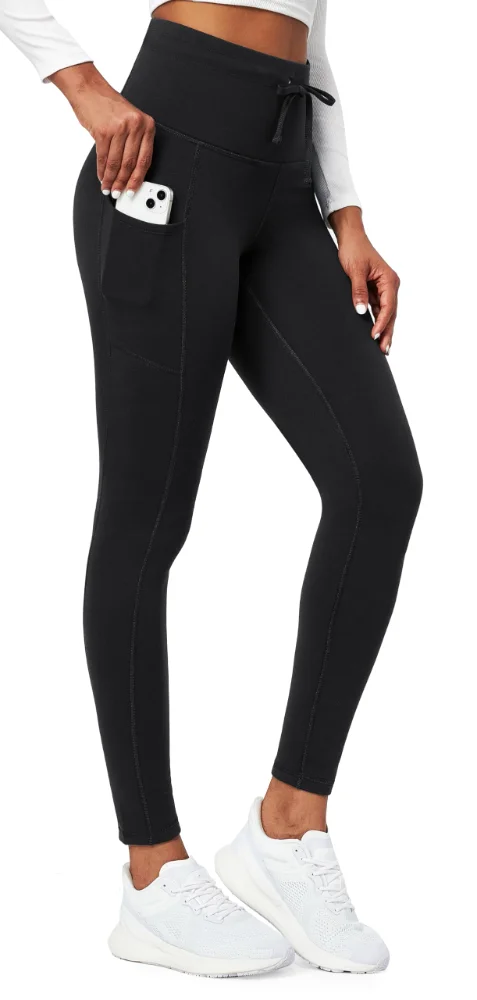
Ewedoos Water-Resistant Fleece Lined Leggings
3 pockets · Fleece-lined · Water-resistant · Sizes XS to 2XL
$23.99
Cotton, polyester blends and the jeggings
Cotton gives a denim look and a familiar hand when you want that feel in a pull-on pant. Our jeggings are made from 54 percent cotton, 35 percent polyester and 11 percent spandex. The cotton creates the appearance and texture that reads like denim. Polyester in the mix keeps the shape after a wash. Spandex is why they pull on easily and spring back into place. That precise combination balances the look of denim with the flexibility and recovery of knit construction.
Dark denim shades can shed a little dye on the first wash. Expect that behavior with dark-colored cotton blends. It is a normal interaction between dye and fiber. The care instruction on the label helps you limit dye transfer. Wash dark colors separately or with like colors when you launder for the first time.
Think of the fabric as loops of thread. The cotton threads make a surface that resembles woven denim, while the polyester threads sit alongside to stabilize the shape. Spandex threads weave through the loops to provide stretch. These are physical facts about how the fabric is built and how it behaves when you move. They are not promises about how the garment will look on your body because the fit still depends on the size you choose.
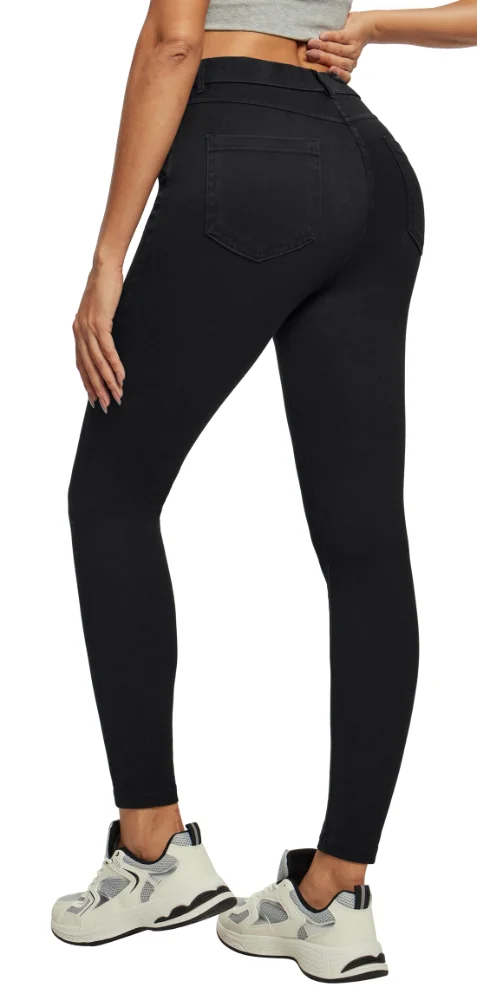
Ewedoos Skinny Pull-On Jeggings
4 pockets · Sizes XS to 2XL · 54% cotton, 35% polyester · Tummy control
$24.99
What moisture-wicking and four-way stretch actually mean
Moisture-wicking is a description of how the fiber moves moisture away from your skin into the outer layers of the fabric where it can evaporate. The knit construction and the fiber choice make this happen. A wicking knit has channels and capillary action at the level of the thread. Polyester is often better at moving moisture along the surface of its fibers. Nylon moves moisture too, but the feel and the drying speed differ. Washing care affects that behavior. Fabric softener can coat fibers and reduce capillary action. That is why care instructions often say no fabric softener on a wicking knit.
Four-way stretch refers to mechanical stretch in two axes. The fabric stretches across the leg and along the length at the same time, and it recovers in both directions. A weave such as a waffle or a Roman twill can be engineered with spandex to allow that freedom. Our dress pants are offered in a waffle weave or a Roman twill with four-way stretch, and one pair is 78 percent polyester, 22 percent spandex. That construction lets you move without the fabric binding in one direction.
In kitchen terms, think of a fiber as a thread and a knit as loops. If you tug on one loop, the nearby loops either give or hold. When the fabric is built to move in both directions, it gives where your body needs it and then pulls back. That is why the percentage of spandex and the knit or weave are both important to the way a garment performs.
UPF, rash guards and keeping the stretch over time
UPF is a fabric rating that tells you the fraction of ultraviolet radiation that reaches your skin through the cloth. A UPF 50 plus rating means the dry, unstretched fabric lets about one fiftieth of the sun's UV through, roughly two percent, on the skin it covers. That measurement covers both UVA and UVB together. The distinction between UPF and SPF matters. SPF on sunscreen measures UVB. UPF measures both UVA and UVB together. Wet or stretched cloth lets more UV through than dry, unstretched cloth. The rating applies only to the area the cloth covers.
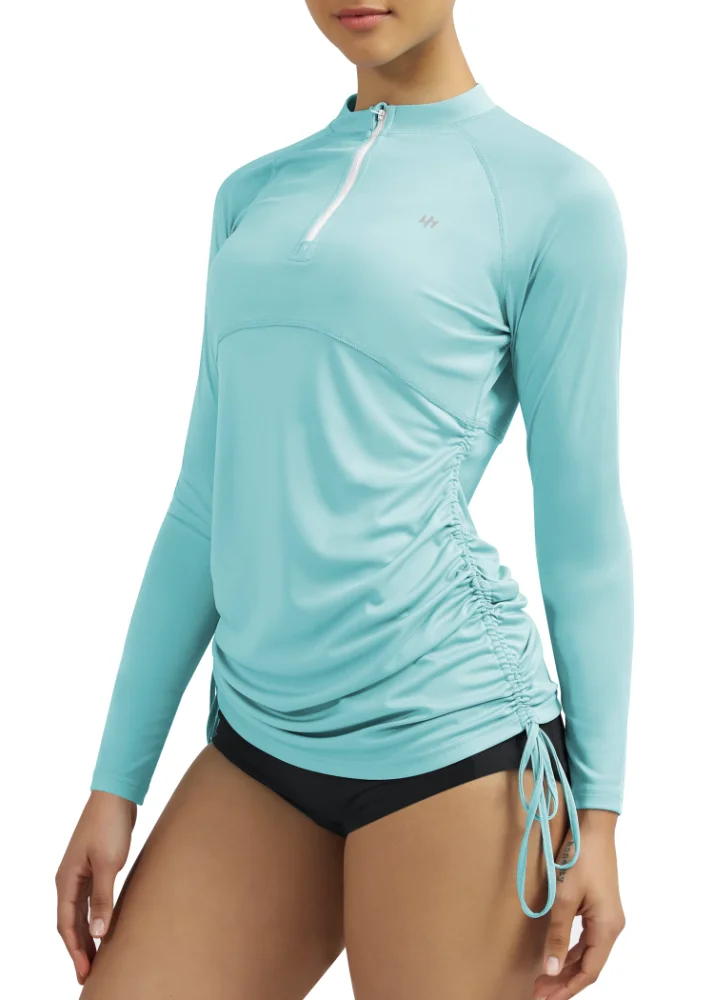
Our rash guards carry a UPF 50 plus rating in the dry, unstretched state. Understand that the protection changes when the cloth is wet or when you pull it tight. The label gives the UPF claim and the fabric blend. For long term care of any stretch garment, wash cold, inside out, and hang to dry. Heat reduces the recovery of spandex. Avoid fabric softener on pieces that claim to move moisture because softener can coat the fibers and reduce their wick.
UPF is printed on the card because it is a measured property of the cloth in its dry, unstretched state and nothing more. Read the label, note the blend, and follow the care instruction. The rating is specific to the fabric, not a promise about skin beyond the fraction it states.
More of this sort of thing is in Fit Notes, and the Ewedoos family keeps the whole range one click away on the front page.
This piece is general information about how activewear fabric is made, labeled and rated, not medical advice. A UPF rating describes a piece of cloth. It does not replace sunscreen on the skin the cloth leaves bare, and a question about your own skin belongs with a clinician.